耐心的大学学习指导老师
重点集中在知识掌握、主动回忆和学习反馈;表达方式耐心、解释充分,教学感最强。
同样是“输入”,语言需要被组织成任务意图,图像需要被拆解成视觉特征。Day 13 用四组实验观察 AI 如何从复杂信息中提取结构、形成判断并输出结果。
Language prompts and visual images appear different, yet both ask the same fundamental question: how does AI transform raw input into structured interpretation and usable output?
三轮实验没有改变核心问题,只逐步减少任务中的信息缺失与解释空间。点击三轮观察 Prompt 如何“长出来”,以及输出质量如何同步变化。
The core question stays the same. Only role, context, constraints, format and evaluation criteria are progressively added.
“How can I build an effective final-exam study plan?” The answer was broadly correct, but lacked user, time and course constraints.
Role, student profile, 14 days, four courses and different mastery levels produced a practical four-stage plan with priorities.
Format, length, tone, constraints and evaluation criteria turned the answer into an executable and reviewable specification.
Accuracy 60 → 82 → 96 · Structure 60 → 84 → 98 · Style fit 42 → 80 → 96 · Usability 48 → 84 → 97.
The strongest change across the three rounds was not prompt length by itself, but the progressive removal of ambiguity. Round 01 gave the model only a goal, so it could not know how many courses existed, how much time remained or what counted as a good answer. Round 02 introduced the user, role, schedule and workload, allowing the model to organize a targeted plan. Round 03 also defined the expected structure, length, voice, limits and evaluation criteria. This effectively described the acceptance standard before generation. A strong prompt therefore creates a clear task boundary: what the model must solve, for whom, under which constraints, and what a verifiable result should look like.
回答整体正确但比较泛化。AI 知道“应该做什么”,却不知道具体对象、课程数量、剩余时间与目标标准,因此难以形成可以直接执行的计划。
Day 1—2|诊断与规划:整理考试日期、范围、章节、历年题,并把知识分成 A 已掌握、B 基本理解但不熟练、C 明显薄弱,后续优先投入 B/C。
Day 3—9|重点强化:每天安排 2—3 门课程;上午处理最高难度课程,下午完成第二重点课程,晚上通过题目、闪卡或口头复述进行检测。采用“学习 → 合上资料回忆 → 做题 → 检查错误”。
Day 10—12|综合练习:减少单纯看书,提高历年题、Tutorial 和模拟题比例,建立错题与薄弱点清单。
Day 13—14|考前收束:集中复习高频考点、错题、核心公式与易混概念,完成一次限时模拟并保证正常睡眠。
加入“大学学习规划顾问、4 门课程、14 天、不同掌握程度”等信息后,答案开始围绕真实约束组织时间轴、课程优先级与每天学习重点,可执行性明显提高。
整体策略:先判断每门课程的考试紧迫度、难度与薄弱程度,把更多时间投入高风险课程,通过主动回忆、练习题和模拟考试持续验证效果。
四阶段:Day 1—2 诊断;Day 3—8 核心强化;Day 9—12 练习与查漏;Day 13—14 考前收束。
标准复习日:09:00—11:00 最高优先级课程;11:15—12:00 闭卷回忆与小测;14:00—16:00 第二优先级课程;16:20—17:20 第三门课程快速回顾;19:30—21:00 历年题 / Tutorial / 综合练习;21:00—21:20 整理错误与明日任务。
优先级:依据“考试紧迫度 × 课程难度 × 薄弱程度”动态调整,不平均分配四门课程时间。
5 分钟复盘:今天真正掌握了什么?哪些内容仍无法独立解释?做错了哪些题?哪门课风险最高?明天最重要的三个任务是什么?
失败预案:计划过满 → 每天只保留 3 个核心任务;只看资料不检测 → 每学完一部分就闭卷回忆或做题;平均分配时间 → 每两天重评课程优先级。
第三轮把“什么样的结果才算合格”也写入 Prompt,因此输出从一般建议升级为结构明确、可以直接执行并方便检查的任务方案。
三轮实验最明显的变化,并不是提示词越长,答案就一定越好,而是模型获得的任务信息越来越明确。第一轮只有“制定复习计划”这一目标,AI 虽然能够回答,但不知道对象有多少门课程、距离考试还有多久,也不知道回答最终需要达到什么标准,因此只能输出比较普遍的学习建议。第二轮加入角色、对象、时间和任务条件后,模型开始围绕“14 天、4 门课程、掌握程度不同”等真实约束进行规划,回答的针对性和可执行性明显提高。第三轮进一步规定输出结构、篇幅、语言风格、限制条件和评价标准,相当于提前告诉模型“什么样的答案才算合格”,因此结果更加稳定、清晰,也更方便直接执行和比较。这说明提示词优化的核心并不是堆积复杂术语,而是降低任务中的信息缺失和解释空间。高质量 Prompt 本质上是在建立清晰的任务边界:模型需要解决什么问题、为谁解决、受到哪些限制,以及最终结果应该长什么样。
同一个问题穿过不同“角色棱镜”后,模型会重新排序什么信息最重要。角色设定改变的是分析视角,而不仅仅是说话方式。
Passing the same question through different role prisms changes what the model prioritizes. A role changes the analytical lens, not only the voice.
The prompt asks for diagnosis of mastery, course priorities and evidence-based learning methods. The response emphasizes knowledge, method and feedback: learn, retrieve without notes, solve a problem and verify mastery.
The prompt asks for direct execution rules without empty encouragement. The response emphasizes priority, measurable output and three mandatory tasks plus two optional tasks per day.
The prompt asks for efficient but sustainable planning without medical diagnosis. The response emphasizes stress, task breakdown, rest and lowering the barrier to action.
All three roles are useful, but the learning advisor best fits the complete task because it answers three questions together: what to learn, how to learn it, and how to prove it has been learned. The experiment shows that a role changes attention, not just tone.
重点集中在知识掌握、主动回忆和学习反馈;表达方式耐心、解释充分,教学感最强。
重点变为时间利用率、任务完成度和可检查产出;语言更短、更直接、更强调执行。
重点转向压力、任务拆解、休息与长期可持续性;语言最温和,强调降低行动阻力。
三种角色都能提供有效建议,但如果目标是完整解决“如何制定高效的期末复习计划”,学习指导老师最合适。原因是期末复习不仅是时间管理问题,还涉及知识掌握程度、课程优先级、学习方法和结果检测。时间管理教练更擅长提高执行效率,但对具体学习方法关注较少;校园心理辅导员能够降低压力并提高计划的可持续性,但学科学习策略相对弱一些。学习指导老师能够同时回答“学什么、怎么学、如何判断是否学会”三个问题,因此信息覆盖最完整,也与任务本身最匹配。
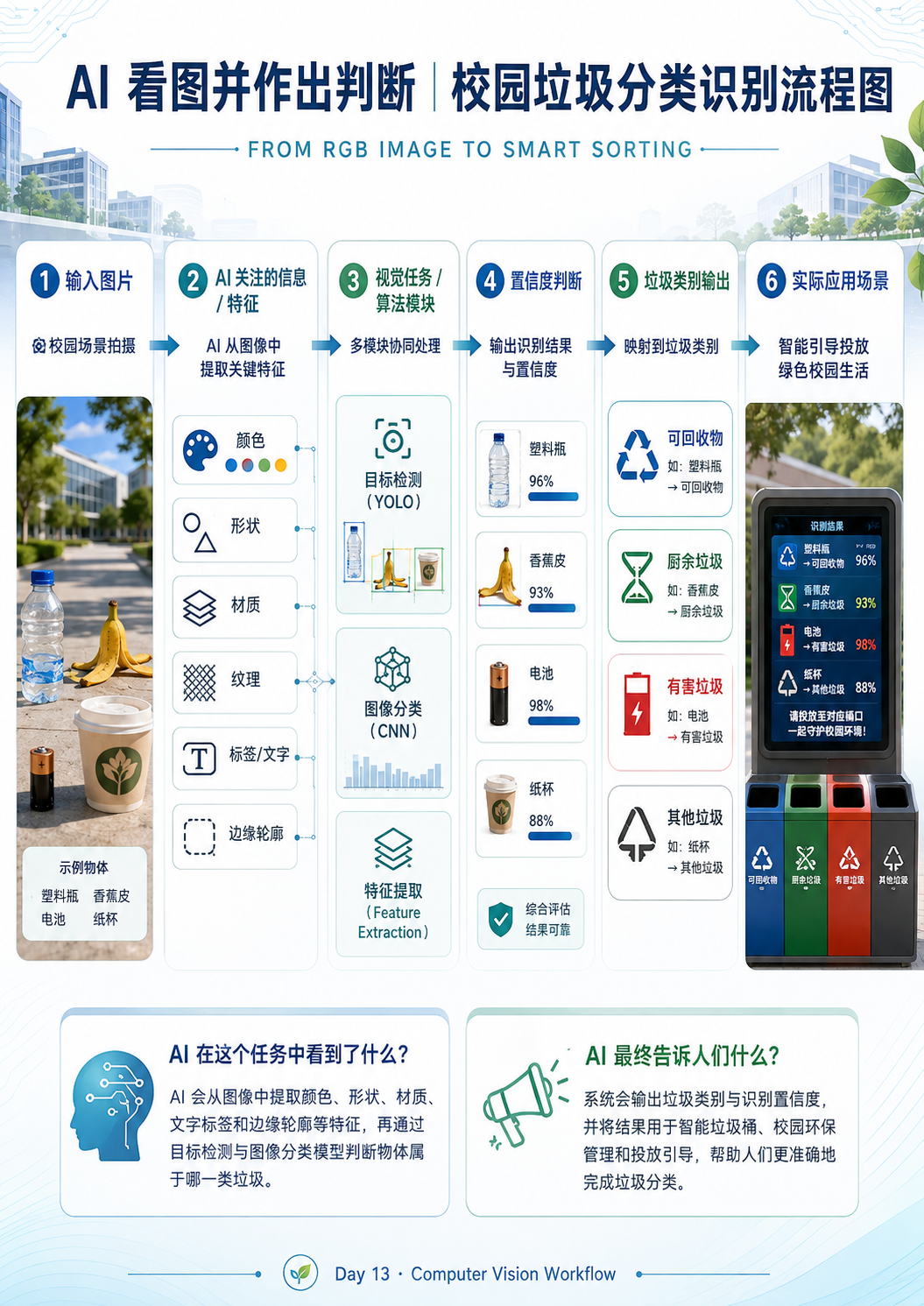
选择场景中的不同物体,观察模型可能关注的视觉特征、识别置信度与垃圾分类结果。完整流程图作为实验说明与证据保留在下方。
Select an object to inspect the visual features, detection confidence and mapped waste category. The full pipeline remains available as formal evidence.
RGB image → visual features → YOLO / image classification → confidence → waste category → smart sorting.
Transparent blue color, cylindrical contour, plastic material and cap structure → recyclable.
Yellow color, curved contour, organic material and surface texture → food waste.
Black/copper color, cylindrical shape, metal material and terminal structure → hazardous waste.
This pipeline uses campus waste sorting as a real-life computer-vision scenario. A camera captures the item, after which the system extracts color, shape, material, texture, label and edge information. YOLO object detection and image classification identify the object and estimate confidence. The resulting object label—plastic bottle, banana peel, battery or paper cup—is then mapped to recyclable, food, hazardous or other waste. The final output guides a smart bin, completing the path from visual input to feature extraction, model judgment and practical action.
本案例选择校园场景中最常见、也最容易与计算机视觉结合的任务:通过摄像头识别待投放物品,并判断其对应的垃圾类别。实验中使用的具体物品是:
AI 看到了什么:透明材质、圆柱轮廓、黄色弯曲形状、金属端点、杯状结构等视觉特征。
AI 最终告诉人们什么:这是什么物体、识别置信度是多少、应该投放到哪一类垃圾桶。
本流程以“校园垃圾分类识别”为真实生活场景,展示 AI 从获取图像到形成实际判断的完整过程。系统先读取待投放物品的图片,再提取颜色、形状、材质、纹理和边缘等视觉特征,并通过 YOLO 目标检测与图像分类模型判断物体类别,同时输出识别置信度。之后,系统把“塑料瓶、香蕉皮、电池、纸杯”等识别结果映射为“可回收物、厨余垃圾、有害垃圾、其他垃圾”等垃圾分类结果,最终用于智能垃圾桶和校园投放引导,实现从“看见”到“判断”再到“应用”的完整视觉链路。
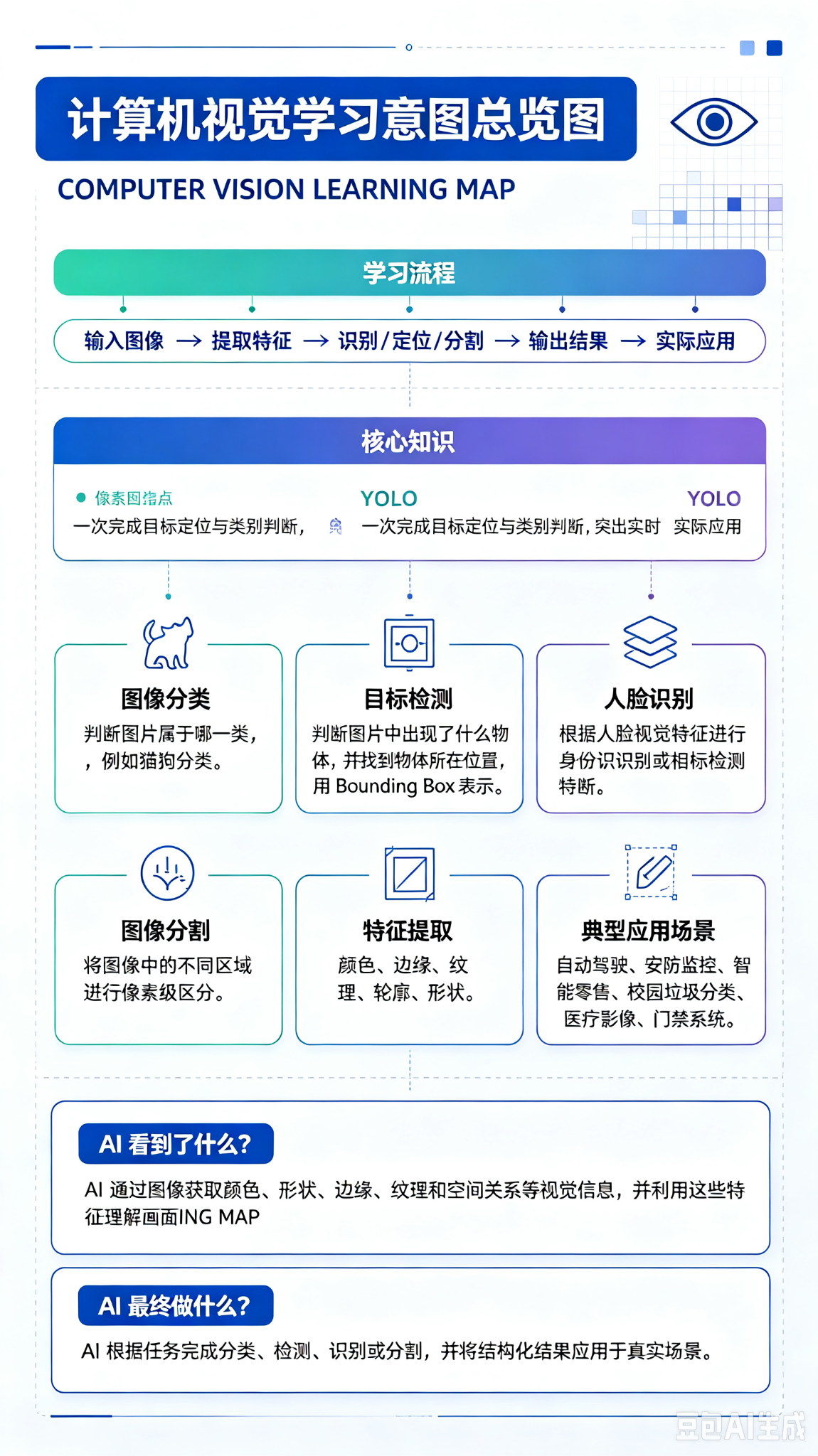
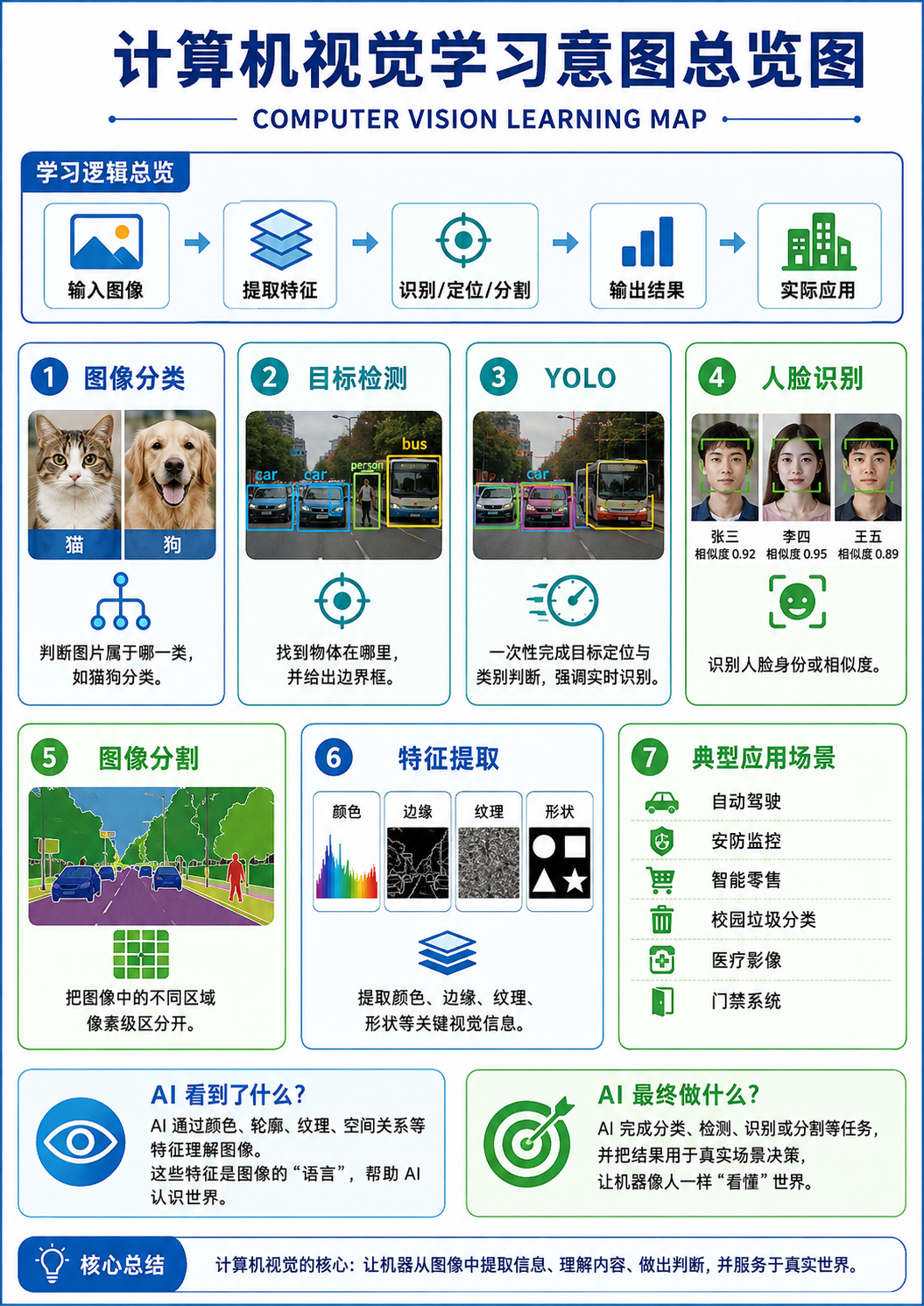
ChatGPT Image 与豆包 AI 使用相同任务提示词。拖动中间滑杆直接比较两张最终候选图,再展开查看豆包一次生成的四个方向与真实操作证据。
ChatGPT Image and Doubao AI received the same prompt. Drag the divider to compare the selected outputs, then inspect Doubao's four visual directions and process evidence.
CHATGPT IMAGEDOUBAO AI
Both ChatGPT Image and Doubao AI received the same prompt for a vertical Chinese “Computer Vision Learning Map.” The controlled variables were topic, knowledge modules, Chinese-text requirement and portrait format; the generator was the primary variable.
ChatGPT Image preserved the requested knowledge structure more consistently; Doubao offered broader layout exploration.
ChatGPT Image produced more stable long-form Chinese text and a clearer process-to-module reading path.
Doubao’s four candidates demonstrated strong variation and a cohesive contemporary infographic style.
Under the same prompt, the two tools organized information differently. ChatGPT Image more completely represented the course structure and visual examples, with clearer separation between classification, detection, YOLO, face recognition and segmentation. Its Chinese labels were also more stable. Doubao’s strength was layout exploration: one run produced four visually distinct directions with a clean modern style. This experiment therefore selects ChatGPT Image for the final learning map because knowledge accuracy, completeness and legibility are the first priorities. The ratings apply only to this Day 13 experiment and are not an official benchmark.
在完全相同的提示词下,ChatGPT Image 与豆包 AI 呈现出明显不同的生成特点。ChatGPT Image 对课程知识结构和视觉案例的还原更完整,图像分类、目标检测、YOLO、人脸识别和图像分割等模块之间区分清楚,中文文字也更加稳定。豆包的优势主要体现在版式探索,一次生成了四种不同的信息图结构,整体设计简洁现代,但部分方案存在知识缺失、文字错位和字符异常。说明评价图像生成结果不能只看画面是否美观,还需要同时检查内容准确性、文字可读性、信息结构与任务适配度。
对于“课程知识总览图”,知识准确性、完整性与文字可读性优先于视觉装饰。ChatGPT Image 对七个核心模块覆盖更完整,并用目标检测、人脸识别、图像分割等真实视觉案例帮助理解。
For a course learning map, accuracy, completeness and legibility matter before decoration. ChatGPT Image better preserved the full knowledge structure and visual examples.
DOUBAO STRENGTH · LAYOUT EXPLORATION真正影响 AI 输出质量的,不只是模型能力,还有输入是否被组织成模型能够理解、判断和验证的信息。
Output quality depends not only on model capability, but also on whether input is organized into signals the model can interpret, judge and verify.